For years, users and many companies have been complaining about cookie banners. Even though this understandable frustration is mostly caused by misleading dark patterns used by the industry, these banners have become the symbol of what is perceived as excessive EU regulation. As part of the ‘Digital Omnibus’, the European Commission now finally wanted to get rid of cookie banners and replace them with an automated signal. However, Google and some of the very EU Member States that are actually calling on the EU to “simplify” and “cut red tape” – including Germany and France, for example – are now standing in the way. In the Council’s latest position paper of 18 June, the plan to abolish the cookie banner has been scrapped. This baffling outcome is likely to continue to cost European users a great deal of hassle, frustration and billions of clicks per year.

- Proposal and reasoning of the European Commission (see Article 88b)
- Council position of 18 June (published by Politico)
- Google’s lobbying paper against Article 88b
- Mlex report on Poland's position
- Digital Omnibus background by noyb
“Dark patterns” and annoyance until the right result. In Europe, users cannot simply be tracked. Both online and offline, there is a fundamental right to data protection – including on Meta’s or Google’s platforms, as well as on websites full of tracking adverts. Companies must therefore ask each individual for their consent – or simply leave them in peace. This is done via so-called cookie banners, whereby consent is not only sought for cookies, but usually also for the sharing of data with often thousands of third-party companies. Users should actually have the option here to consent only if they wish to be tracked online of their own free will. Depending on the study, only around 3–10% of people want this. However, through so-called dark patterns (e.g. hidden ‘No’ buttons or pre-ticked consent boxes), the tracking industry achieves consent rates of up to 90%.
With more than 450 million people in the EU, this farce generates several billion (!) clicks a year, causes frustration and is a complete waste of time for consumers – whilst tech giants and the tracking industry rake in billions in profits through “voluntary” tracking. At the same time, it is becoming increasingly clear that the massive harvesting of personal data also poses risks to security and democracy.
Max Schrems: “Cookie banners are not an invention of data protection, but of the tracking industry. Without consent, there is no snooping online. Now there are fears that a simpler way of saying ‘yes’ or ‘no’ will result in a loss of revenue for Google and the like. That is why the tracking industry is currently lobbying as hard as it can to keep the cookie banner. Clearly, it wants to retain the ability to directly manipulate users’ choices.”
The EU's proposal: an automatic signal. In autumn 2025, the European Commission proposed replacing cookie banners with an automated signal that would communicate cookie consent preferences between the device, the user and websites. Even in California – the home state of most tech companies – a similar solution is already in place. Various proposals adapted to EU law have also been around for some time. The EU proposal is actually significantly less radical than the laws in the US because it still allows for consent to be given on a per-website basis. Specifically, the newly proposed Article 88b GDPR would have provided the solution and was a simple example of how reducing red tape can succeed whilst simultaneously benefiting consumers and fair businesses.
Max Schrems: “Browsers already automatically communicate which language I prefer. It’s just as easy to indicate digitally whether you want to be tracked. Technically, this is straightforward and is even enshrined in law in some US states. There are actually a number of technical solutions that could be introduced tomorrow. Europe is lagging completely behind with these antiquated banners. Absurdly, however, Google and the tracking industry want to make it as difficult as possible for people.”
The “Google Paper” and an avalanche of misinformation. However, a secret lobbying paper from Google has thrown a spanner in the works for the European Commission. Using completely far-fetched figures, it argues that without cookie banners, all online advertising would come to a standstill. Google is exaggerating wildly here and assumes there is a central ‘kill switch’ for all advertising. Yet the European Commission has explicitly made it clear that consent should still be possible on a per-website and per-purpose basis. It would therefore be possible to grant consent to quality media outlets in particular – and to withhold it from Google, Meta and the like. Google conveniently ‘overlooks’ this. Particularly absurd is Google’s argument that quality media outlets would suffer from the abolition of cookie banners. Media outlets are exempt from the provision and would therefore not be affected at all.
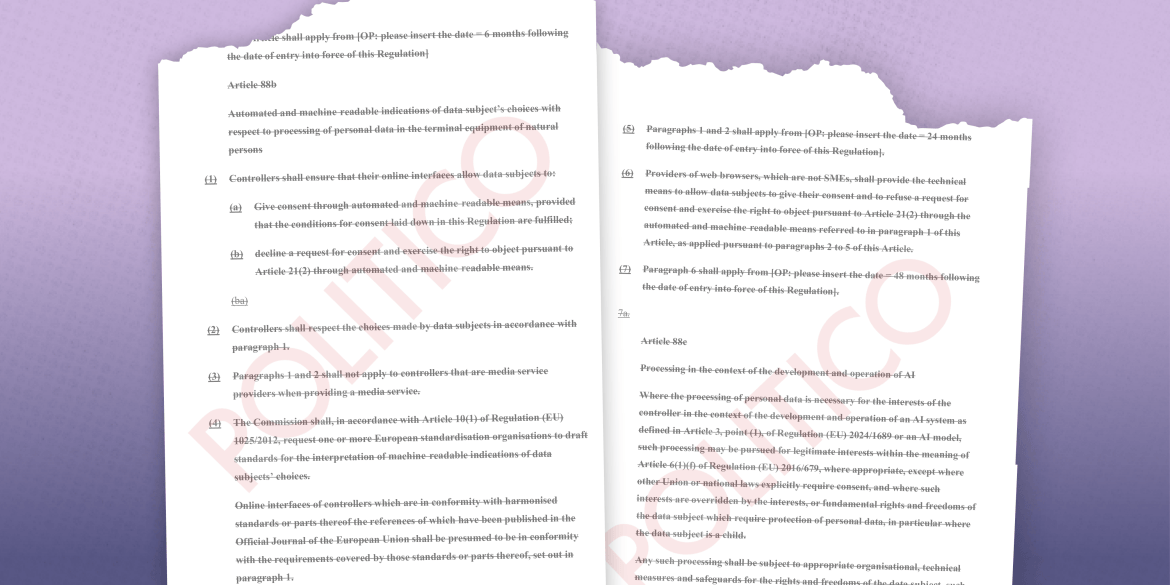
Germany, France and others are now in favour of (!) the cookie banner. However absurd and transparent the arguments of the tracking lobby may be, they seem to have had the intended effect. In the proposal for a final vote in the Council, Article 88b was removed entirely from the Digital Omnibus – and with it, the only measure that would actually have simplified things for consumers. Countries such as Germany, France and Poland had demanded this in advance – presumably following massive pressure from the tracking lobby.
Max Schrems: “You really have to let that sink in: the European Commission finally wants to get rid of cookie banners, but Google and some EU Member States are now determined to keep them. For decades, people have been complaining about EU bureaucracy. But in reality, the tracking industry is so terrified of consumers being able to simply say ‘no’ that, after a bit of lobbying, everyone gives in. It really does raise the question of whether some Member States are primarily representing their voters or the lobbyists.”
The European Parliament has not yet taken a position. The ‘Digital Omnibus’ is currently still the subject of parallel negotiations in the Council and the European Parliament, although the latter has not yet made its position on Article 88b known. At the end of the negotiations, the two institutions will then have to reach a compromise. It is therefore essential that the European Parliament now advocates for the retention of Article 88b. However, here too, the conservative EPP is likely to tip the balance, as it is also under pressure from the tracking lobby.
Max Schrems: “In a democracy, what the majority of people want should actually happen – in this case, getting rid of cookie banners. If decision-makers prefer to follow the will of the tech lobby rather than that of their voters, then something is very, very wrong here."