If the European Commission and the EU Member States have their way, the so-called Digital Omnibus will result in a fundamental change to EU privacy laws. But what about the European Parliament? To find out more, noyb has analysed more than 1,000 amendments that Members of Parliament (MEPs) have tabled for the GDPR and ePrivacy Directive to shed a light on their actions. This shows that many MEPs are in favour of stripping people of their privacy rights – while others still push back. Go to gdpr-omnibus.eu to see who tries to defend your privacy and who wants to undermine currently existing protections. Look up your MEP by country and political group.
Eliminating protections instead of providing simplification. The European Union is currently in the process of changing its core privacy laws via the so-called Digital Omnibus. Officially, this reform package is supposed to bring simplification for EU businesses while maintaining the GDPR’s alleged “high level of protection”. In reality, lobby groups have quickly taken over the process and convinced the European Commission, many Member States and many Members of the European Parliament (MEPs) to strip people of their privacy rights, mostly for the benefit of Big Tech and AI companies in particular.
Responsibility lies with EU Parliament. Among other things, the European Commission’s original proposal for the Digital Omnibus included the plan to limit the scope of the GDPR so that not even online advertising would be covered. It also planned a free pass for the use of personal data for AI without consent. By now, EU Member States have largely agreed to add these massive loopholes to the GDPR – which only leaves the European Parliament to save the GDPR from being undermined. But what exactly are MEPs doing? For citizens and journalists, this is almost impossible to find out. Therefore, noyb has now sorted and graded more than 1,000 amendments for more/less privacy and also simplification.
On the newly created website gdpr-omnibus.eu, you can find a comprehensive grading of every single MEP who has made amendments, searchable by political group and country.
Max Schrems, Chairman of noyb: “Almost every parliamentarian claims to ‘uphold’ people’s rights, but many do the exact opposite. We bring their intentions to the surface and show who is working on behalf of the people – and who is working on behalf of big tech under the cover of alleged ‘simplification’.”
The biggest defenders and offenders. For the analysis, we counted all changes that would have a positive or negative impact on privacy protections. Almost all MEPs have made amendments that go in both directions, but the tendency is clear: The European People’s Party (EPP) is clearly fighting the hardest against users' rights, having made many amendments that favour big tech. This includes the limitation of the scope of privacy protections and the proposal of far-reaching exceptions for high-risk AI. The European Conservatives and Reformists (ECR) also performed poorly overall. The Patriots achieved a better score, but it was still negative.
The “Sovereigns” and Renew both have an even score of zero (despite some Renew MEPs standing out in a positive way). At the same time, Renew dominates the ranking of most “pushback” against the Commission’s flawed proposals with 5 of the top 10 MEPs in that category. Only S&D, the Left and the Greens have a clear positive overall score. The EPP also holds 10 of the top 10 ranks for the most violations of the EU’s Charter of Fundamental Rights.
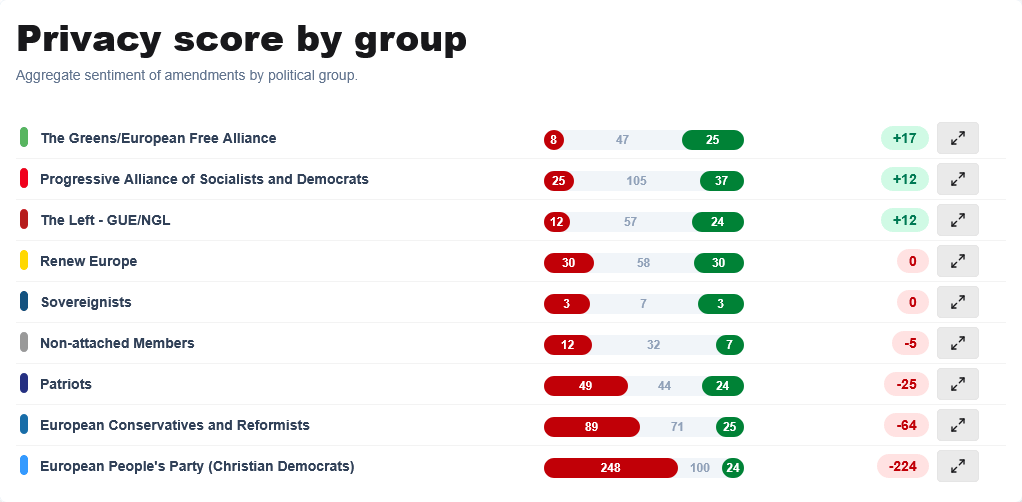
Max Schrems: “Overall, the European People’s Party is clearly the worst for privacy protections and a gift to US big tech. When it comes to privacy rights, even the far-right is more ‘centre’ than the conservatives. The S&D, the Greens and the Left are the only groups that overall defend privacy rights.”
Sacrificing privacy without simplification? The official argument for changing the GDPR is alleged ‘simplification’ for European businesses – all while maintaining current protections. However, noyb also tried to find amendments that would simplify the GDPR without lowering privacy protections. We found that the EPP holds 9 of the 10 top ranks for amendments that result in the opposite: lower protection while also making the law more (!) complicated. At the same time, the Greens, Left, Renew and S&D were indeed proposing amendments that more often squared simplification and privacy.
Max Schrems: “Overall, the conservatives managed to add complexity to the law while also lowering protections. Interestingly, the liberal, centre-left and left parties were more successful in squaring privacy and simplification.”
Tell your representatives what you think! While the situation is far from perfect, we still have time to turn things around – and make sure that Members of the European Parliament will stand up for their constituents and prevent the destruction of fundamental privacy rights in the GDPR. Reach out to your representative in the EU Parliament and tell them what you think. On gdpr-omnibus.eu, you find all the necessary contact information and tips for what to say.
*Methodology. The ranking counts the number of positive amendments and subtracts negative amendments. Leading to an overall positive or negative score. Amendments that are unclear or neutral are not counted. The relevance of each Amendments (big or small change) is not taken into account. You can find more details here.